The cheapest sheet in Malé is often the one that has been stood on edge in somebody's yard for a month, and it is not cheap.
Sheet material is hygroscopic, which is a long word for the fact that it takes moisture out of the air and gives it back again. At the humidity we live in, it is doing that constantly, and how a sheet is stored decides whether it stays usable.
The failure is a bow across the width. It happens when one face of a sheet can breathe and the other cannot, or when a sheet is supported in a way that lets gravity help. A sheet stood on edge against a wall has one face against still air and the other against a wall, and it is being held by its own weight in a curve. Four weeks of that in Malé produces a bow of four to nine millimetres, which I have measured many times on board customers have brought back.
You cannot take it out. A bowed sheet can be pulled flat if it is fixed into something rigid, which a wardrobe back or a fixed shelf is. A door cannot, a drawer front cannot, and a worktop certainly cannot, and those are the parts a job actually needs.
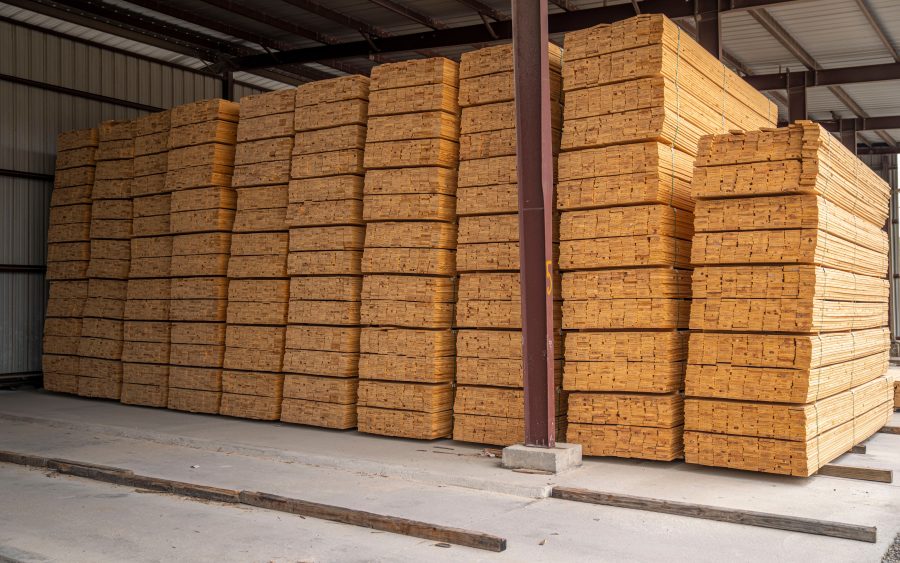
So the rules, for a yard or for a workshop holding ten sheets. Flat, always, on bearers that are level and no more than about two feet apart, with the bottom sheet off the ground so air moves underneath. Under cover, out of direct sun, because a sheet with the sun on one face dries that face and cups. Cover the top sheet, which otherwise acts as a sacrificial lid and always ends up the one you cannot use. And turn the stack if it is going to sit for months, which we do here and which nobody with a small workshop needs to worry about because their stock moves.
Two more specific things. Laminate sheets should be stored flat too, and used within about a month, because a rolled or standing sheet develops a memory that fights you when you lay it on a board. And timber should be stacked with battens between the layers so air can move through it, not solid, which traps moisture in the middle of the pile.
The reason this matters commercially is that board is sometimes offered in this country at thirty or forty rufiyaa a sheet below the going rate, and there is almost always a reason. One of our customers bought forty sheets that way, lost the doors of a twenty two door job, and spent a week of his programme saving twelve hundred rufiyaa.
When you buy board anywhere, ask for a sheet from the middle of the stack. The top one is always flat.